D2C Live Commerce Trends & Tips for 2026

Words by
Lucid
Edited by
Cassie
Operational trends and practical tips for D2C live commerce in 2026. From why it captures fandom, sales, and customer data all at once, to real results from fashion, beauty, and home & living brands, and a pre-launch checklist.
D2C live commerce is establishing itself as a ‘marketing routine’ that builds short-term sales and long-term customer assets at the same time. This article outlines why brands run D2C live commerce, the results they can expect, four operational trends for 2026, and a pre-launch checklist.
Why Do So Many Brands Run D2C Live Commerce? Capturing ‘Short-Term Sales’ and ‘Long-Term Customer Assets’ at Once
Brands that run D2C live commerce consistently commonly cite three reasons for doing so. The first is ‘building and expanding a fandom (loyal customers)’. Through live commerce, brands can communicate closely with customers and build trust over time.
The second is ‘sales growth’. During live sessions, conversion actions such as adding to cart, downloading coupons, and signing up for membership occur actively and lead quickly to purchase, directly impacting sales. Another major strength of D2C live commerce is the ability to directly secure the data of customers who enter the live session. With the customer data you collect, you can build repurchase strategies and connect naturally into CRM operations.
What Kind of Results Can You Expect from Live Commerce, and How Much?
Running live sessions consistently genuinely contributes to D2C store growth.
In fact, many brands experience ‘cumulative sales growth and an increase in returning customers’ as they establish a regular monthly operating system. When you manage key performance indicators (KPIs) such as purchases, add-to-cart actions, and membership sign-ups alongside regular live operations, you can create synergy with CRM and advertising and expect a ‘sales expansion effect.’
Live sessions that have ended can also keep generating sales.
When you repurpose the real-time video content created during a live session into short-form videos and expand its exposure across placements such as detail pages and ads, you can see ‘an increase in ROAS (return on ad spend)’.
Cases from Shoplive’s clients prove this. Fashion brand R saw its live purchase conversion rate rise 2.8x, and home & living brand V repurposed its live clips into short-form videos to generate an additional $29,780 in sales. Beauty brand A built a fandom based on live commerce and saw growth in loyal customers who purchase regularly.
D2C live commerce is not a one-off event that ends after a single run; it is establishing itself as a ‘marketing routine that builds a brand’s growth structure.’
‘2026 Live Commerce Operation Trends’ Worth Knowing Before You Start
① More Brands Are Running Platforms and Their Own D2C Stores in Parallel
Major platforms (such as Naver Shopping Live and Kakao Shopping Live) have the advantage of high traffic, but they come with limitations: heavy commission fees and difficulty securing control over customer data. As a result, the strategy of using platforms to capture new inflow while also running D2C live commerce to directly accumulate and use customer data is expanding. When you secure member data and purchase-behavior data based on D2C live commerce, operations that extend into personalized marketing and CRM become possible, and the limitations of platform live commerce can be complemented as well.
② Advancing the Live → Short-Form → Ad and CRM Expansion Strategy
When you view live commerce not as a ‘one-time sales broadcast’ but as the channel where a brand can produce high-quality video content most efficiently, its range of uses expands dramatically. After a live session ends, if you repurpose the video into short-form clips, ad creatives, detail-page content, and more, and distribute it across various channels, you can naturally expand the funnel beyond the purchase conversion that live commerce traditionally handled to include the awareness and interest stages. In other words, a single live session becomes the starting point of a flow that runs from building early interest to content consumption and conversion.
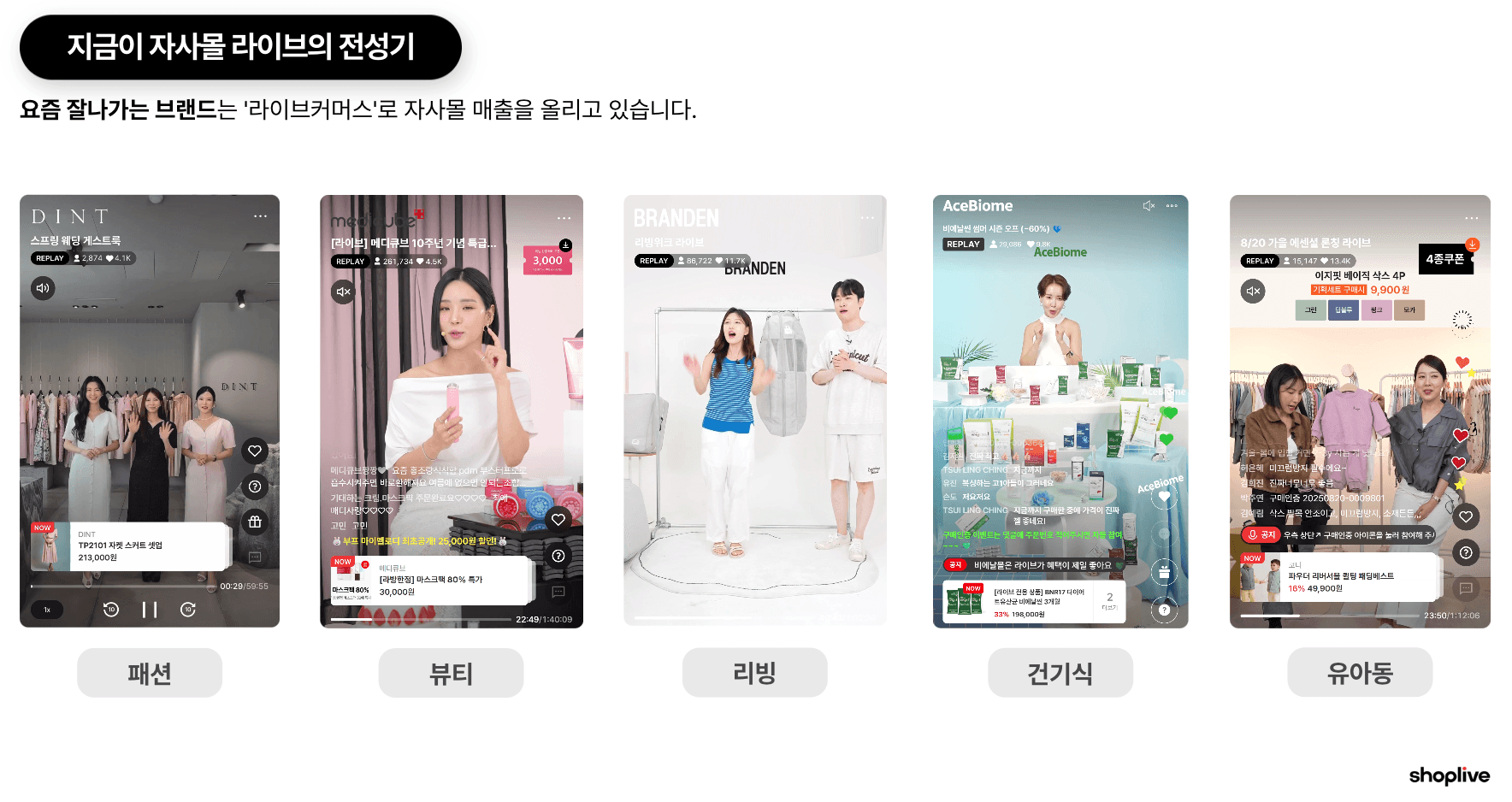
③ Less Reliance on Influencers, More Brand-Centered Operation by CEOs, MDs, and Others
Recently, live commerce has been moving away from influencer-centered operation that simply gathers traffic toward a format in which internal personnel, such as the brand’s CEO or MDs, host the sessions directly. When the person who knows the product best hosts the live session, expertise and credibility naturally rise, and customer feedback can be reflected quickly in product planning and marketing strategy. When a brand builds live-operation capabilities in-house, it can lower external dependence while securing both cost efficiency and operational continuity.
④ A Shift Toward Focusing on ‘Purchase Performance (KPIs)’ Rather Than Viewer Count
As the live commerce market matures, its key metrics are also changing. Rather than the simple number of viewers, metrics tied to actual revenue, such as ROI (return on investment), conversion rate, and purchase contribution, are becoming more important. In particular, D2C live commerce can integrate with GA (Google Analytics) or an internal CRM to measure conversion data precisely, so you can more clearly identify which content, audience, and timing lead to results.
Now, D2C live commerce is settling not into the experimental stage of “Should we give it a try?” but into the stage of designing “what structure will let us run it better.”
Why Brands Choose ‘Shoplive’ for ‘D2C Live Commerce’
Shoplive is not simply broadcast streaming; it is a solution that supports the entire range of operations needed to turn D2C live commerce into sales. It integrates reliably with Cafe24 D2C stores, and category-specialized MDs support online and offline onboarding so you can quickly establish your live-operation system.
In addition, it provides a full-package solution that connects targeted advertising, live commerce, short-form video, and CRM into one flow to expand results, and its video AI features help brands avoid missing viewer reactions and momentum: which is why many brands choose Shoplive as their D2C live commerce partner and are achieving results.
Will We Succeed Too? A Pre-Launch Checklist for D2C Live Commerce ✔️
✅ Do you have ‘products of your own’ that you can confidently showcase in a live session? The more differentiated they are, like self-developed or self-sourced products, the more persuasive they are in a live session and the more easily they lead to sales.
✅ Can your brand decide live-exclusive prices and benefits on its own? You need to be able to design pricing and benefits flexibly for live commerce’s immediate-conversion effect to grow.
✅ Do you have staff who can run it consistently at least once a month? The more live sessions accumulate, the more loyal customers and repeat visits grow, and sales also grow steadily.
✅ Can you invest in it as a ‘brand growth strategy’ rather than a short-term event? To grow the impact, you need to also design operations that connect short-form distribution, CRM, and advertising after the live session.
With D2C live commerce, ‘a structure you can run consistently’ produces results more than ‘an event you pull off once.’ In 2026, create bigger sales with D2C live commerce together with Shoplive!
Frequently Asked Questions
Q. Why run D2C live commerce?
There are three reasons: building a fandom (loyal customers), increasing sales, and securing customer data. With the data you collect, you can connect all the way through to driving repurchases and CRM operations.
Q. Does D2C live commerce actually produce results?
Yes. Fashion brand R saw its live purchase conversion rate rise 2.8x, and home & living brand V repurposed its live clips into short-form videos to generate an additional $29,780 in sales.
Q. What should you check before starting live commerce?
Check whether you have differentiated own-brand products, the authority to decide live-exclusive prices and benefits, staff to run it at least once a month, and the will to invest in it as a brand growth strategy rather than a short-term event.


