The Complete Guide to Live Commerce: A to Z

Words by
Lucid
Live commerce pairs real-time video broadcasting with instant, in-stream shopping, and it has become a core channel for D2C growth. This guide brings together everything you need to launch, from defining the concept to putting it into practice.
No headings found on page
What Is Live Commerce?
Live commerce is a way of selling that uses real-time video to showcase products and lets viewers buy them on the spot, right as they watch. It combines the immediacy of TV home shopping with the convenience of online shopping, but its biggest difference is the layer of two-way interaction such as chat, quizzes, and auctions. Viewers ask the host questions in real time, see how other shoppers are reacting, and claim perks available only during the broadcast.
The whole point is to erase the distance between "watching" and "buying." Where traditional e-commerce explains a product through photos and text on a product page, live commerce has a host wear and use the product firsthand and answer viewers' questions on the spot. That process builds trust, and trust translates directly into conversions. So live commerce is best understood not as a simple broadcast but as a sales channel built for real-time persuasion.
The essence of live commerce is closing the gap between "watching" and "buying": a sales channel built for real-time persuasion.
Four things set live commerce apart from other ways of selling.
Two-way conversation in real time: size, texture, how a garment actually falls — the things a photo can't settle. A viewer asks, and the host demonstrates the answer on the spot.
Checkout without leaving the screen: the purchase happens on the same screen as the broadcast.
Shoppertainment: quizzes, auctions, and prize wheels lift dwell time and impulse purchases together.
A low barrier to entry: no studio gear required. A phone is enough, which is how small brands and individual sellers entered the market.
Live Commerce vs. TV Home Shopping: What's the Difference?
If TV home shopping is a supplier-driven, linear format broadcast one way on a fixed schedule, live commerce has a flexible format that can go live anytime through mobile and web, free of time and place constraints. The decisive difference is that live commerce invites active participation: viewers jump into the broadcast through real-time chat and engage in close, two-way conversation.
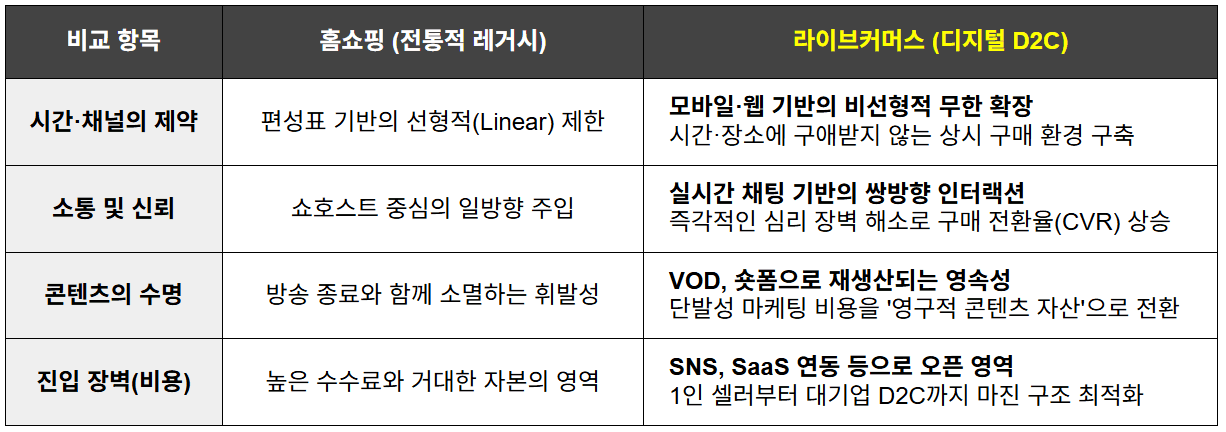
Category | TV home shopping | Live commerce |
|---|---|---|
Direction | One-way broadcast | Two-way, driven by chat |
Medium | TV channel | Mobile app and web |
Scheduling | Fixed programming grid | Sellers open a stream whenever they want |
Host | Professional show hosts | Show hosts, influencers, or the seller |
Barrier to entry | Broadcast rights, high commissions | A phone and an account |
Checkout | Phone order or a separate app | Instant checkout inside the stream |
Customer data | Held by the broadcaster | Platform or brand, depending on setup |
In the digital era, home shopping companies are evolving fiercely to survive as well. They are adding live commerce's "agility and digital technology" to their traditional strengths of "strong planning, production know-how, and credibility," transforming into vast media-commerce platforms.
Why Does Live Commerce Keep Growing?
Because consumers are shifting from "reading" about products to deciding by "seeing" them, and because brands are reaching a point where they must build direct relationships with customers instead of leaning on advertising. For a generation that consumes video as a daily habit, a static product page alone rarely gives the confidence to buy. Real-time video conveys a product's texture, size, and use intuitively, which lowers return rates and raises purchase satisfaction.
On top of that, rising ad costs and tighter privacy regulations keep driving up the cost of acquiring new customers. Live commerce is an efficient channel that reaches many potential customers in a single broadcast while driving conversions at the same time, with the added benefit that broadcast data accumulates directly as a brand asset.
The market data says the same thing. Global live commerce was worth roughly US$250 billion in 2025 — Precedence Research puts it at $254.4B, Grand View Research at $252.3B — and it is growing around 20% a year. Korea follows the same curve. Across the D2C stores and vertical platforms running on Shoplive, the number of products listed in live rose 53.6% year over year in 2025, average listed price climbed 15%, and listings above 3 million KRW (US$2,100) grew 3.3x. Live is shifting from a channel that announces discounts to one that builds confidence.
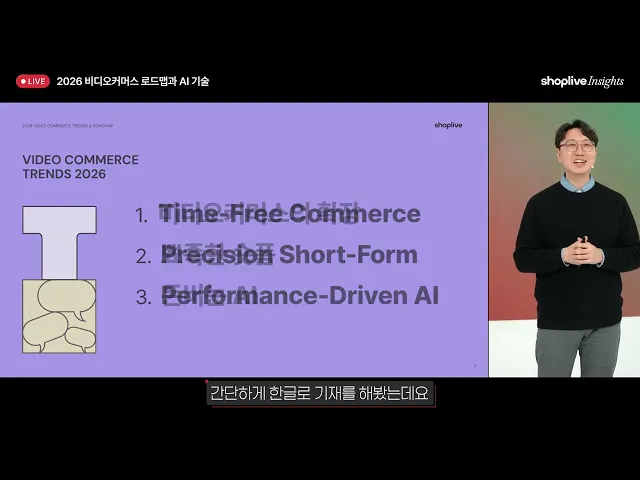
Live Commerce Trends for 2026
The key currents in live commerce for 2026 come down to three.
A shift toward D2C: More and more brands are broadcasting directly from their own stores to avoid handing commissions and customer data to outside platforms.
Combining live and short-form: Reworking a single live broadcast into several short clips for always-on exposure is becoming the standard.
Data-driven personalization: Targeting ads and retargeting powered by viewing and purchase data increasingly decide the outcome.
For more detail, see 2026 D2C Live Operations Trends and the video below.
Live Types: D2C Store vs. Open Platform
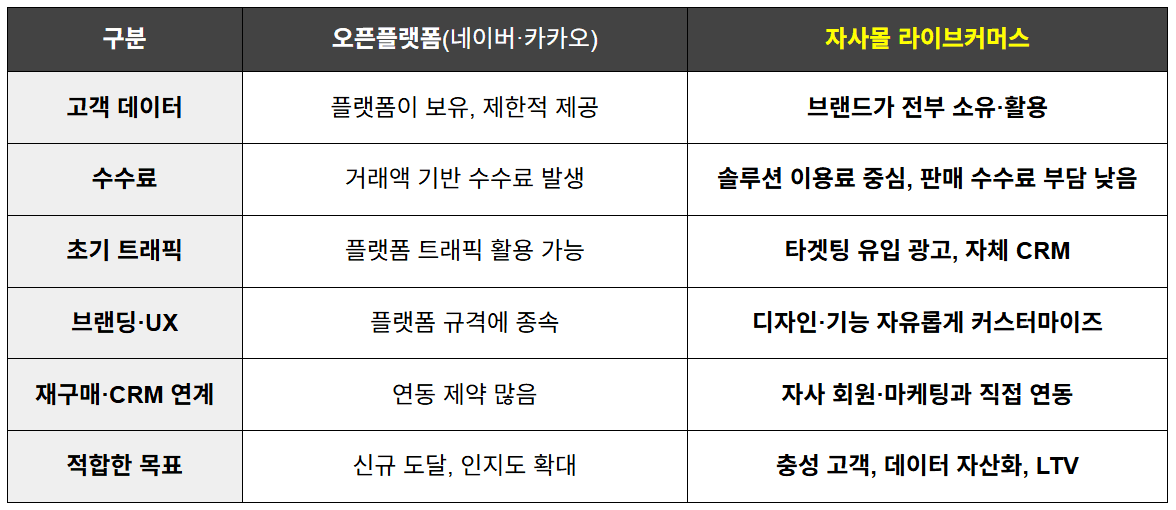
Live commerce broadly splits into running broadcasts directly on your own D2C store versus using an open platform like Naver or Kakao. D2C live commerce means opening broadcasts inside a brand's own website or app, so the brand fully owns the customer experience and the data, while an open platform layers your broadcast on top of already-established, large-scale traffic.
The two are not substitutes; they are options you choose between or run together depending on your goal. If you're after new-customer acquisition and early reach, an open platform has the edge; if you're after deeper relationships with loyal customers, repeat purchases, and data accumulation, a D2C store wins. Many brands use a dual strategy: widening awareness through open platforms while locking in relationships through their D2C store.
Which Live Commerce Platforms Are Used in Korea?
There are two routes to going live in Korea: list on a platform that already has traffic, or embed broadcasting into your own store. Which one you pick decides your commission structure and who ends up owning the customer data.
Type | Name | What defines it |
|---|---|---|
Platform listing | Naver Shopping Live | The largest in Korea; mostly Smart Store sellers |
Platform listing | Kakao Shopping Live | Tied into KakaoTalk gifting |
Platform listing | Coupang Live | Connected to Rocket Delivery logistics |
Platform listing | 11st LIVE11 | Built on open-market traffic |
Platform listing | Grip | Started as a dedicated live shopping app |
Platform listing | YouTube Shopping | An affiliate model where creators link products |
D2C embed | D2C live (solution-based) | An SDK dropped into the brand's own app or site; data and margin stay with the brand |
Listing on a platform makes the early audience easy, but you pay a sales commission and the viewing data stays with the platform. Embedding in your own store means building the audience yourself, but everything from watching to checkout happens on your domain, so data and margin stay with the brand and connect to your existing member records and CRM. Plenty of brands run both: platforms to widen awareness, their own store to hold the relationship.
Live and Short-Form: What Role Does Each Play?
Live is the real-time conversion channel that makes people "buy now," and short-form is the always-on discovery channel that lets people "find you anytime." The two aren't rivals; they divide the labor within a single content pipeline. Live broadcasts drive immediate purchases through the scarcity of time and perks, and they build trust through dense, high-touch interaction with viewers.
Short-form commerce, by contrast, keeps the content working long after a broadcast ends. When you cut highlight moments from a single live broadcast into short clips and place them across your D2C product pages, homepage, and social media, even customers who missed the broadcast can watch the key moments anytime and go on to buy. In other words, the ideal design is to create peak moments with live and reuse those moments for the long haul with short-form. For a hands-on guide to this connective structure, see Designing Live Commerce and Short-Form That Drive Sales.

What Makes Live Commerce Succeed
Successful live commerce happens when three elements interlock: content, perks, and technology.
Simply turning on a broadcast won't lift sales; watch time and conversion rise together only when the conditions below are in place.
A stable viewing experience: Smooth streaming and fast checkout integration are the fundamentals and a precondition for conversion.
Clear product curation: Focusing on a few competitive hero products rather than many items speeds up the purchase decision. Add customer perks and coupons on top to encourage bundled purchases.
Interaction that drives engagement: Chat, quizzes, games, and real-time perks keep viewers glued to the broadcast and prevent drop-off. The longer the watch time, the more conversion opportunities you get. Whether chat questions actually get answered is the pivot: in a measured case where an AI chatbot lifted response rate 5x, viewers who got an answer stayed up to 58x longer.
Traffic design: Plan the traffic flow in advance, from pre-broadcast alerts to in-broadcast ads to post-broadcast retargeting.
Post-broadcast asset-building: Reusing a broadcast through replays (VOD) and highlight clips makes the impact of a single broadcast last.
How to Choose a Live Commerce Solution
You should choose a live commerce solution based not on its "broadcasting" feature but on the entire flow that turns broadcasts into sales and data. That means looking past stable streaming quality to viewer engagement features, post-broadcast content reuse, ad and CRM integration, and how easily it embeds into your D2C store. Evaluating a live commerce solution through this lens makes the choice clear.
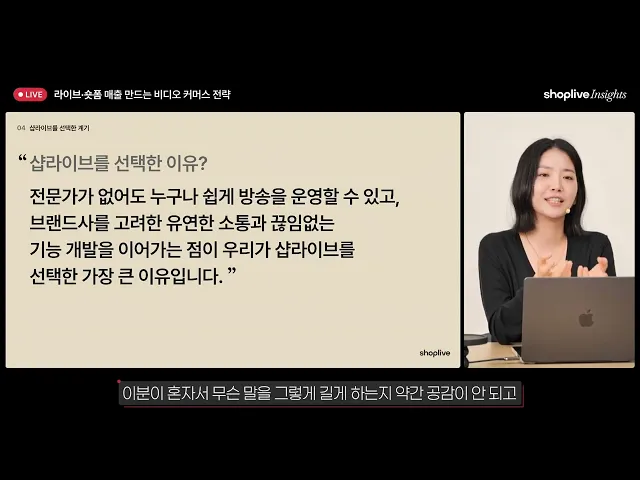
Shoplive is a video commerce solution used by 240 brands across 20 countries, and it meets every one of these criteria. In Korea, brands like MUSINSA, 29CM, Ohou, Yeogi Eottae, and APR use it; globally, eBay, Catawiki, AEON, KOSÉ, and @cosme have adopted it to run live commerce across platforms and their own channels.
Here are the standout features that set Shoplive apart.
Broadcasting: High resolution, stability, and WebRTC-based streaming with ultra-low latency of about 0.1s.
Mobile SDK: Viewers can keep watching the live broadcast even after leaving the app.
Quizzes, games, and dedicated broadcasts: Interact with viewers in real time to boost participation and dwell time while reducing drop-off.
Highlight clips: Cut the key moments from a long live broadcast and reuse them as short-form commerce content.
Live replay (VOD): Customers who missed a broadcast can watch and buy anytime, extending the life of each broadcast.
Targeting ads: Korea's first live commerce targeting ads, exposing broadcasts precisely to interested customers. For details, see the TargetAds introduction.
SNS short-form import: Pull short-form videos you've already posted on Instagram, YouTube, and more into your D2C store to unify your content assets. Learn how in Importing SNS Short-Form.
Landscape mode (16:9): Support for landscape broadcasts as well as vertical, enabling varied productions like unboxings, demos, and interviews.
The core selection criterion: can a single solution handle the entire process: traffic (targeting ads, CRM) → dwell time (PIP, mobile SDK, quizzes) → click and purchase conversion (perks, product grouping) → post-broadcast asset-building (highlight clips, short-form, replay)?
Shoplive Case Studies
Shoplive delivers live commerce results for companies regardless of size or industry. Across fashion, travel, home living, and D2C stores, the companies that have adopted Shoplive use it not as a simple sales broadcast but as a channel to meet new customers, make their brand memorable, and maximize revenue.
Gamtanbra: Designed a purchase journey into its D2C live and grew hourly sales by more than 4x.
Yeogi Eottae: 16 broadcasts over three months for cumulative sales of 14 billion KRW (US$10M), with 25% first-time buyers per broadcast.
29CM: 12x higher average daily live sales; 1.5 billion KRW (US$1.1M) in just four hours on OR's launch day.
MUSINSA: MUSINSA Live averaged 120 million KRW (US$86K) in sales and 60,000 viewers per broadcast.
Ohou: Averaged 290,000 viewers and 500 million KRW (US$360K) in sales per broadcast, with 14 million cumulative views in its first year.
SSF Shop: Strengthened real-time styling conversation with "SESAPAE LIVE," hosted by celebrities and influencers.
Zigzag: Up to 4x higher same-day live sales, surging 415% on MIXXO's broadcast day.
Ably: Up to 24x higher Q4 sales for participating stores, with a 150% increase in viewers.
The results above are compiled from recent press releases by companies that have adopted Shoplive. Gamtanbra in particular drove its results by shortening the purchase path with product pop-ups and CTAs; you can find its detailed operating approach in the Gamtanbra live commerce case study, and you can also see D2C success stories in the R2W video below. As these examples show, live commerce is establishing itself as a gateway for new-customer acquisition, not just a sales channel.
A Checklist Before You Launch Live Commerce
Before adopting live commerce, check your goals, content, and operating systems first: before the broadcast gear. Working through the items below in order can greatly reduce trial and error.
Define your goal: Be clear on whether this live is about sales, acquiring new customers, or promoting a new product. Your goal changes both your D2C-vs-open-platform choice and your KPIs.
Channel strategy: Decide whether you want a D2C store (for data and relationship-building), an open platform (for early reach), or a combination of both.
Product lineup: Trim the number of products per broadcast and design your hero products and perks in advance.
Content pipeline: Plan ahead for how you'll reuse highlight clips and replays after the live.
Traffic and ad design: Prepare the flow of pre-broadcast alerts, in-broadcast targeting ads, and post-broadcast retargeting.
Solution validation: Compare solutions on streaming stability, engagement features, D2C embedding, and CRM/ad integration.
Staffing and rehearsal: Divide the roles of host, chat moderation, and technical support, and rehearse beforehand to prepare for the unexpected.
If you're seriously considering adoption, request a Shoplive demo to see the actual screens and features, and find the live commerce setup that fits your brand.
Frequently Asked Questions (FAQ)
Q. How is live commerce different from TV home shopping?
TV home shopping is broadcast one way on a fixed channel and schedule, whereas live commerce can go live anytime on mobile and web, lets viewers interact in real time through chat and quizzes, and keeps working after the broadcast through replays and clips. Another big difference is the low barrier to entry, which lets small and mid-sized brands and sellers run broadcasts themselves.
Q. Should I choose D2C live commerce or an open platform?
It depends on your goal. A D2C store is the better fit if accumulating customer data, driving repeat purchases, and having branding freedom matter most, while an open platform like Naver or Kakao is the better fit if you urgently need early reach and new awareness. Many brands use a parallel strategy: widening their funnel through open platforms while locking in relationships through their D2C store.
Q. How do I use live broadcasts and short-form together?
The ideal approach is to create the peak of real-time conversion with live, then cut that broadcast's key moments into short-form such as highlight clips and place them always-on across product pages, your homepage, and social media. Live handles immediate purchases, while short-form handles the ongoing discovery and traffic from customers who missed the broadcast.
Q. What criteria should I use to choose a live commerce solution?
Look beyond broadcasting features at streaming stability, engagement features like quizzes and pop-ups, post-broadcast asset-building such as highlight clips and replays, targeting ads and CRM integration, and how easily it embeds into your D2C store. The key is whether a single solution can handle the entire process of traffic, engagement, and asset-building.
Q. Does live commerce actually deliver results?
Yes. For example, Gamtanbra grew hourly sales by about 4x in a broadcast that featured just four products, and Yeogi Eottae recorded roughly 14 billion KRW (US$10M) in sales over three months through its own live, with about 25% first-time customers. Focusing on a few products, interacting in real time, and reusing content after the broadcast are the common factors behind these results.
Q. Which live commerce platforms are used in Korea?
On the platform-listing side: Naver Shopping Live, Kakao Shopping Live, Coupang Live, 11st LIVE11, Grip, and YouTube Shopping. Separately, brands can embed broadcasting directly into their own app or site. The first route is better for early reach; the second for owning customer data and margin.
Q. How big is the live commerce market?
Globally it was worth about US$250 billion in 2025 and is growing roughly 20% a year. In Korea, Shoplive data shows products listed in live up 53.6% year over year in 2025, average listed price up 15%, and listings above 3 million KRW (US$2,100) up 3.3x.


