Ohouse Live Commerce: There's a Reason It Sells

Words by
Lucid
Ohouse, one of Korea's largest home and interior platforms, runs its own live commerce channel called Ohouse Live inside its app and on the web. In the year since launching in April 2025, the channel aired 158 broadcasts and drew 14 million cumulative viewers, working with 101 participating brands along the way.
Furniture and home accents are hard to judge from photos alone. Color, scale, how a piece actually fits a room: none of that comes through on a product page. When the question "how would this look in my place?" goes unanswered, the purchase gets put off.
Ohouse tackled that head-on with live video. A host places and uses the product in a real space, in real time, and answers viewer questions the moment they land in chat.
Ohouse Live: One Year on the Record
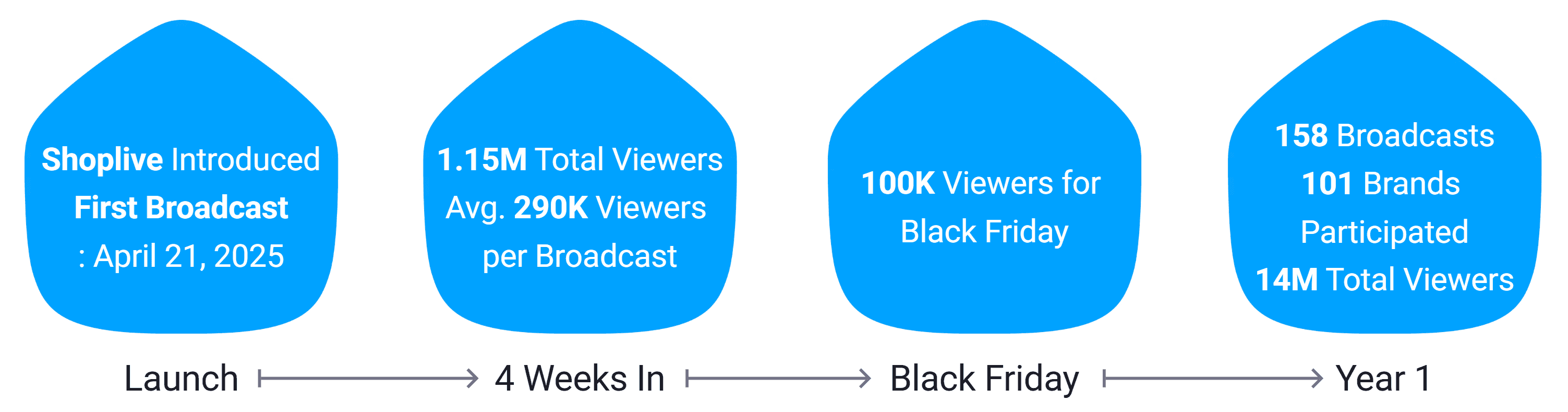
The start. First broadcast on April 21, 2025, scheduled every Monday. Viewers watch and buy right inside the Ohouse app and website, powered by Shoplive's video commerce system.
Week four. 1.15 million cumulative viewers, 290,000 average viewers per broadcast, and 500 million KRW (about US$360K) in sales per show. Even through April and May, the off-season for furniture and living, brands taking part in Ohouse Live set all-time daily sales records.
The big sale. The Black Friday event as a whole drew about 20 billion KRW (about US$14M) in cumulative sales over two days, and about 100,000 people tuned in to the Black Friday live broadcast.
One year. 158 broadcasts, 101 participating brands, 14 million cumulative viewers, and a peak of 300,000 viewers on a single broadcast.
What the Data Tells Us
Ohouse scaled up fast: about three broadcasts a week. It started with one broadcast a week. Eleven months and 158 episodes later, that had nearly tripled. Live commerce went from a weekly experiment to a core part of how Ohouse introduces new brands to its audience.
Per-episode viewership settled around 90,000, and stayed there. The first four weeks were outliers: a handful of launch broadcasts pulled in 290,000 viewers each. After that early spike, viewership leveled off to a steady average, sustained by repeat viewers through follower and notification opt-ins and by CRM outreach: not by one-off promotional pushes.
Brand reach came from breadth, not repetition. 101 brands appeared across 158 broadcasts: roughly one and a half episodes each on average. Ohouse used its live slot to keep introducing new brands rather than building a rotation of repeat favorites.
What Makes Living Live Different
Fashion live shows how something looks on. Beauty live shows how a color pays off on skin. Living live shows something bigger: a finished space. Ohouse's data points to four traits that set the living category apart.
It shows the whole space, not just the product. Confidence to buy comes from seeing the room a product creates, not just the product on its own. A single sofa is a lot less convincing than the living room that sofa builds.
It's closer to discovery than comparison shopping. Viewers aren't there to compare prices. They're there for the "oh, I could style it like that" moment: the kind of taste discovery that turns a broadcast into a lifestyle pitch rather than a sales pitch.
User content does the persuading. Real rooms that real users have posted (UGC) are far more convincing than staged product shots. Ohouse builds that community content directly into its broadcasts.
Consultation closes the deal. Furniture and renovation are big-ticket, high-consideration purchases. Live Q&A gives buyers a place to work through that hesitation in real time, and the trust it builds is what turns a viewer into a buyer.
How Ohouse Runs It
Ohouse started as a content community: a place where users shared their own spaces and borrowed ideas from each other's interiors. Live commerce was layered on top of that later.
That history is what sets Ohouse Live apart. Broadcasts don't just introduce a product: they weave in real interior content that users have already posted, so viewers watch a space get transformed rather than a product get pitched.
Agora Lighting, a premium lighting brand with no prior live experience, beat its sales targets through visual staging and real-time interaction. It's a clean example of what living live does best: a well-composed scene sells the product for you.
Ohouse is now extending live beyond furniture and appliances into renovation services like kitchen remodels: a natural next step for a platform built around real-time consultation on big decisions.
The Takeaways, and Shoplive
None of this is unique to living. The pattern holds for any product that's hard to explain and needs to be seen to sell: the harder a category is to describe in text, the more live commerce pays off.
Living also has a timing problem that other categories don't share as sharply. Demand clusters around moving season and year-end, with real dead zones in between. That's exactly why turning broadcasts into lasting assets matters so much. Shoplive's replay and highlight-clip features let a single broadcast keep selling long after it airs. April and May are normally the slow season for furniture and living, yet brands taking part in Ohouse Live set their best daily sales records: which ties back to that same structure of turning broadcasts into assets.
High-ticket, high-consideration purchases like furniture, lighting, and renovation come with their own friction. Buyers need to judge texture and finish in person, and they worry about delivery, installation, and refund terms. Ohouse leaned hard into real-time chat and consultation to work through exactly those concerns before they became reasons not to buy.
Want to sell high-ticket, high-consideration products live, the way Ohouse does? Shoplive can help. Request a demo.
📰 In the News
[Money Today (May 26, 2025)] Ohouse launches live commerce: "290,000 viewers per show, 500 million KRW in sales"
[ET News (Apr 29, 2026)] Ohouse's live commerce turns one, tops 14 million cumulative viewers
[Hankyung (Nov 20, 2025)] Black Friday discounts land: Ohouse hits 20 billion KRW in cumulative sales over two days
Frequently Asked Questions (FAQ)
Q. How well has Ohouse Live performed?
Since its first broadcast on April 21, 2025, it aired 158 broadcasts in one year and reached 14 million cumulative viewers. 101 brands took part, average viewership per broadcast was 290,000 in the first four weeks, and sales ran 500 million KRW (about US$360K) per show. Its peak was 300,000 viewers on a single broadcast.
Q. Can products with long decision cycles, like interiors, really sell live?
The higher the consideration, the more live commerce actually helps. Showing a product in a real space in real time, and clearing up questions instantly over chat, raises buyer confidence. Brands taking part in Ohouse Live set all-time daily sales records even in the April to May off-season for furniture and living, which backs this up.
Q. What sets Ohouse Live apart?
It puts the experience of a space, not price, at the center. It weaves user-posted interior content (UGC) into broadcasts to show how a product transforms a space, and pairs that with its community assets to build trust. Extending into high-consideration services like kitchen renovation through real-time consultation is another distinctive move.
Q. How do we add live commerce to our own D2C store?
With a video commerce solution like Shoplive, you can build a first-party live channel through a simple SDK integration: no heavy custom development required. Ohouse adopted the same system in partnership with Shoplive. Viewing-convenience and asset-building features like replays, highlight clips, a mobile SDK, and the ability to import short-form clips from social come standard.
If you are just starting to look at live commerce, The Complete Guide to Live Commerce covers the definition, the platforms used in Korea, and how to choose a solution — all in one place.


