
D2C Live Commerce: Ultra-Premium Items Up 3.3x
Words by
Shoplive
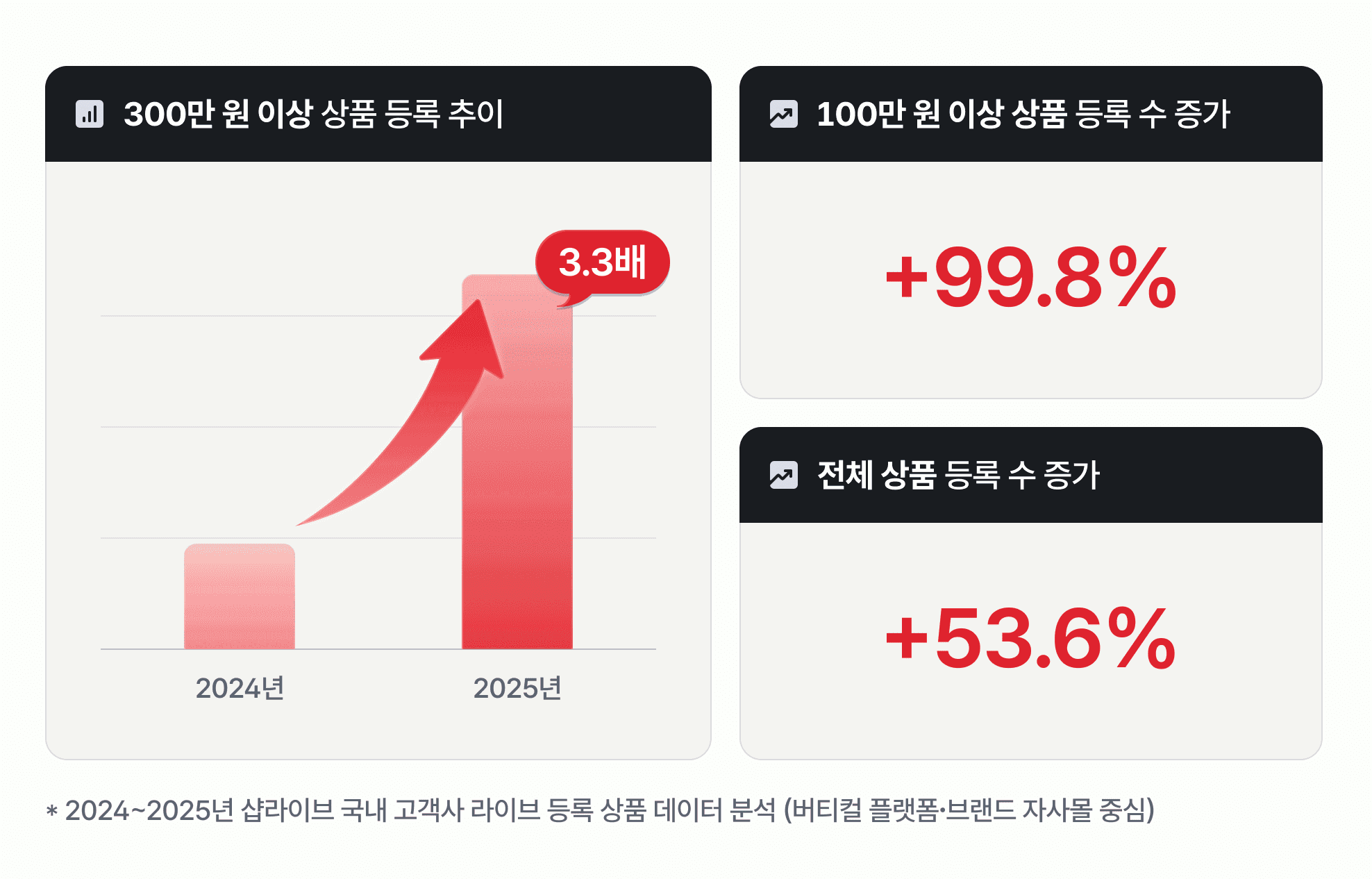
Shoplive pre-releases its "2026 Video Commerce Playbook." In the D2C and vertical live commerce market, ultra-premium products priced over $2,000 grew 3.3x and registered products rose 53.6%: we share these growth metrics for high-consideration, premium live commerce.
In the independent live commerce market centered on D2C stores and vertical platforms, high-priced premium products are growing rapidly. An analysis of Shoplive's own solution operating data shows that the number of registered products rose 53.6% year over year in 2025, while ultra-premium products priced over $2,000 grew 3.3x.
(Shoplive = 2026/04/09) Shoplive (CEO Kiyoung Kim), a global video commerce solution company, pre-released the key data of its "2026 Video Commerce Playbook" on the 9th, based on an analysis of live commerce operating data conducted through its own solution. The data shows that, unlike the open live commerce market led by major portals such as Naver and Kakao, the independent video commerce market centered on D2C stores and vertical platforms is also seeing qualitative and quantitative growth driven by high-priced premium products.
D2C and specialized-platform live commerce expands: registered products up 53.6% year over year
In 2025, the number of products registered for live commerce by Shoplive's domestic clients surpassed 100,000, up 53.6% from the previous year. The figure counts only products that major vertical platforms and brand-owned stores actually scheduled for live sessions. This shows that, beyond an increase in broadcast volume, the range of product categories and price points featured in live commerce is also diversifying.
Shoplive is the solution that category-specific vertical platforms and brand-owned stores use to run their own live sessions, rather than on Naver or Kakao Shopping Live. With category-leading platforms such as MUSINSA, Ohouse, Yeogi Eottae, and eBay using Shoplive's solution to run live commerce, the data can be read as a reference indicator of the real trends in Korea's D2C and vertical-platform-led live commerce market.
Upper price tiers grow thicker: ultra-premium products over $2,000 up 3.3x
The most notable change is the growing share of high-priced product segments. According to an analysis of registered product prices, the number of high-priced products registered at over $660 nearly doubled in 2025 compared to the previous year, and their share of all products also climbed to a record high.
The change was even greater in the ultra-premium segment priced over $2,000. The number of products registered in that tier grew 3.3x year over year, and its share more than doubled. The average product price also rose about 15% from the previous year. In other words, alongside the increase in the total number of products, the share of ultra-premium products rose as well. Live commerce is expanding into a channel that can carry premium products where explanation and trust matter, not just low- and mid-priced goods.
Reaching into living, travel, and services: premium product portfolios spread
This shift is attributed to high-ticket categories entering live commerce in earnest. Living and travel are representative examples. Ohouse, which began live commerce last April, has continued to feature high-ticket products such as large home appliances and furniture, and brands including Kyungdong Navien, Bodyfriend, and Winix are also actively running D2C live sessions. Indeed, the growth in high-priced product registrations was clear in the living and home appliance category as well.
Premiumization was also evident in the travel category. Modetour introduced a premium package in the $5,000 range through a live session, and Yeogi Eottae has recently begun using live commerce as a full-fledged sales channel. Live commerce is also broadening into high-consideration service areas. SK Rent-a-Car introduced popular models such as the Hyundai Grandeur, Genesis G80, and Tesla Model S through live sessions and closed long-term rental contracts. Beyond these, high-priced items such as pure gold bars worth over $6,600 and original artworks in the $20,000 range have also appeared in live commerce.
This trend was not limited to categories newly entering live commerce. In fashion, a long-standing core category, the top of the high-priced segment also grew thicker, further broadening the product portfolio featured in live commerce. That said, the entire market has not uniformly shifted to higher prices. The median product price changed little, but the average price rose: suggesting that the market is being reshaped into a structure in which growth is driven by the rapid increase of upper-tier products rather than by an across-the-board price rise.
Global trends point the same way: "2026 Video Commerce Playbook" released
Similar trends are continuing in overseas markets as well. Global platform eBay stated in a recent earnings announcement that eBay Live's GMV expanded roughly 7x year over year on a run-rate basis, and it is scaling up live events centered on luxury and collectibles.
Shoplive has released its "2026 Video Commerce Playbook," which contains these statistics along with video commerce trends and brand success stories. A Shoplive representative said, "Live commerce is now evolving beyond simple selling into a channel that can persuasively introduce even high-priced, high-consideration products where explanation and trust matter," adding, "We hope this playbook serves as a practical reference for companies thinking through their video commerce strategies."
See it on video
The same data, presented on video.
Products listed — The number of products listed in live grew 53.6% year over year in 2025.
High-end goods — Eight Rolexes a minute, four or five luxury bags — that's the kind of pace people describe now. Luxury categories trade actively online.
Live auctions — One auction seller reported passing US$7 million in three hours of live.
Frequently Asked Questions
Q. Is the D2C and vertical live commerce market actually growing?
Yes. In 2025, the number of products registered for live commerce by Shoplive's domestic clients surpassed 100,000, up 53.6% from the previous year. Beyond the number of broadcasts, the product categories and price points being covered are also diversifying.
Q. Are high-priced products sold through live commerce too?
Yes. The number of ultra-premium products registered at over $2,000 grew 3.3x year over year, and high-consideration products, including pure gold bars, original artworks, premium travel packages, and long-term rentals of imported cars, are also being sold through live commerce.
📝 Worth reading next
Media Inquiries
Shoplive Brand Communications Team / pr@shoplivecorp.com


