Aesthetic Medicine's First Live Commerce Show

Words by
Roanne
Edited by
Kaylee
💡 The short version
The compliance guide came first, before any planning. No claims of guaranteed results, no prices on screen, nothing that reads like a testimonial: those rules were set up front, and that's how the team handled medical advertising risk.
On air, a Q&A structure and a list of likely questions absorbed the surprises. Behind that sat a collaboration where brand, clinic, and tech each owned a clearly defined piece.
Live will spread through aesthetic medicine carefully and in stages. But live AI technology is already bringing the barrier to entry down.
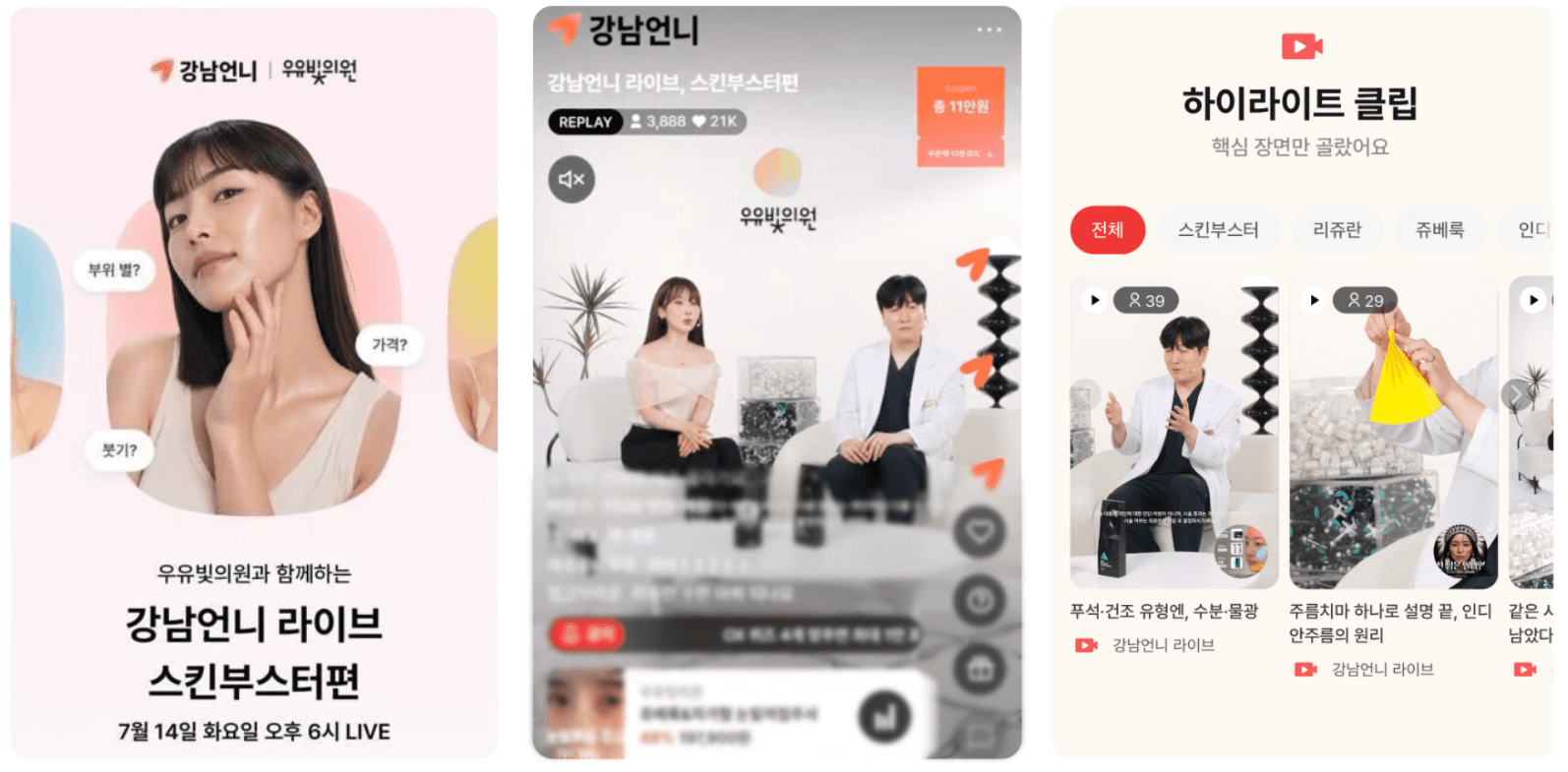
Cosmetic surgery and injectables have long looked like the wrong fit for live commerce. Under Korea's Medical Service Act, every single phrase carries legal weight: so a format built on going live looked like risk itself. Then, on July 14, 2026, Gangnam Unni, the Korean aesthetic medicine platform, ran one anyway: the first in the industry. What made it possible was production discipline and technology working together. We sat down with Cha Kyung-in, Executive Director at The CNM, the live commerce production company behind the planning and production, to ask how it actually came together.

Clearing the Medical Advertising Bar
Q. You've done a lot of online branding work in fashion and beauty. Compared to those projects, this one must have felt different from the very first prep meeting. How was it?
The biggest difference is that we started from "what we can't say," not "what we want to say." In fashion or beauty commerce, the whole game is how attractive you can make something look. In a medical live stream, every line of the script has to sit inside medical advertising rules. So before we wrote the run of show, we wrote a compliance guide. No claims of guaranteed results, no prices on screen, no testimonial-style language: we set those rules first, then designed the fun inside them. The usual order, completely inverted.
Q. Aesthetic medicine draws a lot of advertising-review scrutiny, so the creative side must have come with far more constraints than a typical live commerce show. What did you watch most closely?
Three things, mainly. First, keeping procedure footage off screen. We explained the mechanics through analogy instead: no needles, nothing invasive, just the principle in words. For a retaining ligament procedure, we compared it to a pleated skirt: pull out the thread holding the pleats, and the fabric falls smooth.
Second, managing who says what. Anything about how the clinic operates had to come from the doctor directly, and the host only asked questions and reacted. The moment a host starts explaining a clinic, it can read as third-party endorsement.
Third, the requirements around before-and-after photos. You need the date the photo was taken, the side effects listed alongside it, and the doctor's explanation: all as a set. The conditions attached to one image add up to about as much copy as a full product detail page. Honestly, knowing those standards or not knowing them is the real barrier to entry in this category. Even the fun elements, the quizzes and the perks, we cleared with legal in advance, right down to separating those lines from anything that prompts a consultation.
📌 Key point.
Set the compliance guide first, then design the show inside it. Then three standards: no procedure footage, controlled speakers, strict before-and-after requirements. That's how this live stream cleared medical advertising risk.
Prepping for What You Can't Script
Q. Having medical professionals as the leads is a big differentiator. That must have called for a completely different approach than directing an influencer. What was it like?
If directing an influencer means turning things up, directing doctors means making it precise and comfortable at the same time. Doctors aren't broadcasters, they're specialists. So what we changed wasn't how they spoke: it was the structure. We took the lecture-style script, where the doctor explains at length on their own, and turned all of it into Q&A: the host asks, the doctor answers. Any line that felt awkward in rehearsal, we rewrote on the spot together, in words the doctor was comfortable with.
And for anything off-script, we put together a one-page ad-lib guide: "phrase it this way / avoid this." That meant whatever came up in the chat, the doctor could take it comfortably, within those bounds.
Q. This was an industry first. Once you were actually running it, did anything surprise you about operations or audience response?
The quality of the chat wasn't what we expected. In regular commerce, most of it is price questions. Here, we got the kind of thing you'd actually hear in a consultation room: "my skin is sensitive, is this safe for me?", "how long does the bruising last?" We'd built an anticipated-question response sheet on exactly that assumption, and it landed almost exactly right. We'd decided in advance how far to answer a question that really needs an individual diagnosis, and where to hand it off to an in-person consultation. So nobody had to make that call under pressure on the day.
📌 Key point.
A script rebuilt as Q&A, plus a response sheet prepared in advance. Those two are why even the surprises on air were already accounted for.
Clear Roles, and the Tech to Back Them
Q. A brand-new category comes with a lot of unknowns. How did you split the work with the brand and the tech team?
Clear roles were the reason it worked.
Gangnam Unni handled the platform, the user data, legal review, and the perk design. The clinic owned the accuracy of the medical information and appeared on camera. We ran planning, script, direction, and everything on the ground. Shoplive handled the technology, and because we've worked together on a number of projects, we know each other's feature specs inside out: so we move fast.
We wrote the script assuming Shoplive's quiz pop-ups, live polls, and instant point payouts right from the planning stage. We'd hand over a run of show with "at this minute, this interaction fires, and every correct answer gets points immediately" baked into the timecode, and it would get built exactly that way. Designing the perk as an instant payout to everyone who answered correctly, rather than a prize draw, was only possible from the start because we knew that feature existed. Lower legal risk, and participation you can actually feel. Understanding Shoplive's technology well turned out to be the answer to the regulatory problem. On the day itself, someone from Shoplive was on site running the stream with us. We've been in sync as teams for so long that even in a category none of us had done before, nothing wobbled technically.
Q. Live means chat is sensitive too. How did you manage comments that might have come up on air?
Because it's live, chat was the variable we could control least.
So that's where we leaned hard on Shoplive's AI Chat Moderation. We set it to filter, in real time, anything that could run afoul of the Medical Service Act, mentions of competing clinics, inappropriate comments. If you try to catch all of that by hand, the show stops. With the technology screening at the front end, operational risk dropped and the host and the doctor could stay on the content. And for viewers, it made for a much safer, more comfortable live stream.
📌 Key point.
Gangnam Unni, the clinic, the production company, and Shoplive each owned a clearly defined piece, and a partnership already in rhythm backed it with technology. That's the background to a first attempt that worked. On live chat risk in particular, Shoplive's AI Chat Moderation screened out Medical Service Act violations and inappropriate comments up front: the foundation for running live with confidence even in a regulated industry.
The Barrier to Entry Is Already Coming Down
Q. With the Gangnam Unni case as a starting point, how do you see live spreading through aesthetic medicine and procedure-based businesses?
I think there's plenty of room for it. The direction will be a bit different from regular commerce, though.
Not "buy now": more likely it settles into informational live streams that build trust. In this category, the consumer's real pain point isn't price, it's information asymmetry: not knowing what's what. The pace, though, will be careful and staged, given the nature of the industry. It's a lot to take on without compliance handled, so early on the cases will pile up around teams with a proven process, and as those cases become the standard, it widens out. And one more thing, cautiously: I think a clinic that does it once is likely to keep doing it. Once you feel the quality of your consultation inquiries change after a live stream, it's hard to go back.
Q. For a brand that hasn't tried live yet, what's the first piece of advice you'd give as a production specialist?
The first thing I'd say is that the brand, the technology partner, and the production company need to start talking at the earliest planning stage. In a category with compliance risk like aesthetic medicine, legal has to weigh in several times just to get one storyboard out, and if you rush the technical rehearsal to right before the shoot, one or two things always come out misaligned. And one last thing. There's no reason to keep putting this off just because of the risk. Before, everyone hesitated because nobody had done it. Now there's a proven case in Gangnam Unni. They carried the weight of going first, so the brands that follow can start with a much lighter load.
📌 Key point.
A careful, staged pace: and a barrier to entry that has already come down. With Gangnam Unni as the first case, expect more brands in aesthetic medicine to try live commerce.
Closing Thoughts
Live commerce is opening up new ground well beyond beauty products, into medical fields like cosmetic surgery and injectables. We're genuinely rooting for Gangnam Unni's first step and the boldness it took to build a new kind of customer experience. Shoplive will keep providing a safe, trustworthy environment for running live, built on AI technology, and keep setting new standards for medical live streams.
Frequently Asked Questions
Q. What comes first when producing live commerce that complies with medical advertising law?
Lock the compliance guide before you write the run of show. Set the standards for prohibited language first, claims of guaranteed results, prices on screen, testimonial-style copy, then design the creative inside that frame. Building a review structure from day one, with the production company, the clinic (or brand), and the platform's legal team all checking together, cuts risk on broadcast day substantially.
Q. Can you explain a medical procedure without showing the procedure itself?
Yes. In this case, the team explained the mechanics through analogy. Comparing a procedure to something everyday, with no needles or invasive footage on screen, raises viewer comprehension and trust at the same time.
Q. What needs the most attention while an aesthetic medicine live stream is on air?
The small details matter. Directing an influencer is about amplifying reactions; directing medical professionals is about preserving the tone they use in a normal consultation. The first step is rewriting the script from lecture-style explanation into a Q&A structure, where the host asks and the doctor answers. Build an anticipated-question response sheet on top of that, set the line for how far to answer questions that need an individual diagnosis and where to hand off to an in-person consultation, and prepare a separate ad-lib guide for answering within those bounds. Then unexpected questions on air won't shake anyone's judgment.
Q. What should a brand entering live commerce in aesthetic medicine for the first time prepare first?
Get the brand, the technology partner, and the production company talking from the earliest planning stage. The more regulated the industry, the more those three aligning in advance reduces the unknowns on broadcast day. Adoption will move carefully and in stages given the nature of the field, but with proven cases and processes already in place, the load on a first-time brand is far lighter.
If you are just starting to look at live commerce, The Complete Guide to Live Commerce covers the definition, the platforms used in Korea, and how to choose a solution — all in one place.


