How Live Commerce CRM Differs From Ecommerce CRM

Words by
Lucid
Edited by
Lucid
💡 The short version
Watch and participation data from a live broadcast mostly ends up as an aggregate. It rarely reaches the CRM as behavior tied to a customer.
Ecommerce CRM follows each customer’s own timeline. Live commerce CRM adds a clock everyone shares, the broadcast, and sorts viewers by watching, participating and coming back.
Once you can tell the 5-minute viewer from the one who left in under 10 seconds, live stops being only a sales channel and starts building customer data.
A few thousand people show up for a single broadcast. One stays for five minutes or more. Another is gone in under ten seconds. Some grab a coupon. Some answer a quiz.
And when the stream ends, what's left is usually a headline number: how many watched, how much sold. Who stayed, who claimed a coupon, who keeps coming back, who reacted to a particular question during the show: none of that reaches your CRM in a form you can use.
The problem isn't your CRM tool. It's that live behavior never gets connected to the segments and automations your CRM already runs. That's where live commerce CRM starts to look different from ecommerce CRM.
Live commerce CRM means recording what viewers do during a broadcast, at the level of the individual customer, and feeding it into the segments and automations you already have. Less about buying a new CRM tool, more about adding one new axis to the one you run today: the broadcast.
Why can't your CRM tell two viewers apart?
Because it never receives the data that would tell them apart.
Take a broadcast with 3,000 viewers. Once it ends, everyone who bought shows up in your purchase history. Everyone else? The viewer who stayed five minutes and the one who bailed in under ten seconds look identical the next morning. To your CRM they're both just "people who didn't buy."
Their actual behavior is nothing alike.
5 minutes or more watched → strong interest
Under 10 seconds watched → low interest, or the content missed
Coupon claimed → intent to buy, or interest in the offer
Coupon claimed, never used → interested, decision postponed
Repeat viewing → sustained interest
Quiz or poll answered → an interest the customer stated outright
If your CRM can't see the difference, everyone gets the same message. That isn't a segmentation mistake. The data that would build the segment simply isn't being put to work.
Why doesn't live data reach the CRM?
Live data and CRM data don't look alike to begin with. A CRM is comfortable with attributes that stick around: signup date, purchase history, membership tier, last order date.
Live data is the opposite, a stream of behavioral events generated and gone inside an hour. Something like this:
LIVE_JOIN· viewer enters the broadcast
LIVE_VIEW· watch time accumulates
LIVE_EXIT· viewer drops off
COUPON_RECEIVED· coupon claimed
COUPON_USED· coupon redeemed
QUIZ_SUBMITTED· quiz answered
SURVEY_SUBMITTED· poll answered
PURCHASE_CONFIRMED· purchase verified in-stream by the viewer
What matters isn't that the event fired. Who, which broadcast, when, how long, and what they responded to all have to travel together before a CRM can do anything with it.
Plenty of brands already run CRM well. In Korea that usually means collecting customers through Kakao Sync, the one-tap signup built on KakaoTalk accounts, messaging them by app push and KakaoTalk alerts, and building segments and campaigns in a CRM platform. The gap sits upstream of all that. Nothing turns live behavior into data the CRM can read.
A CRM consumes data. It doesn't produce it. So however good the platform is, if live behavior never arrives, live viewers stay filed under "visited the app" or "didn't buy."
How much does your CRM already know about viewers?
Quite a lot. App opens, product views, cart adds, purchases, searches, wishlists. That alone is enough to segment on. But most of it is indirect interest. Viewing a product page doesn't mean someone wants the product. A cart add doesn't guarantee a purchase.
Live is different. Five minutes of watch time isn't an inference. It's something the customer actually did. They could have scrolled to something else or closed the app, and they stayed. That makes live data a genuinely new signal next to everything your CRM already collects.
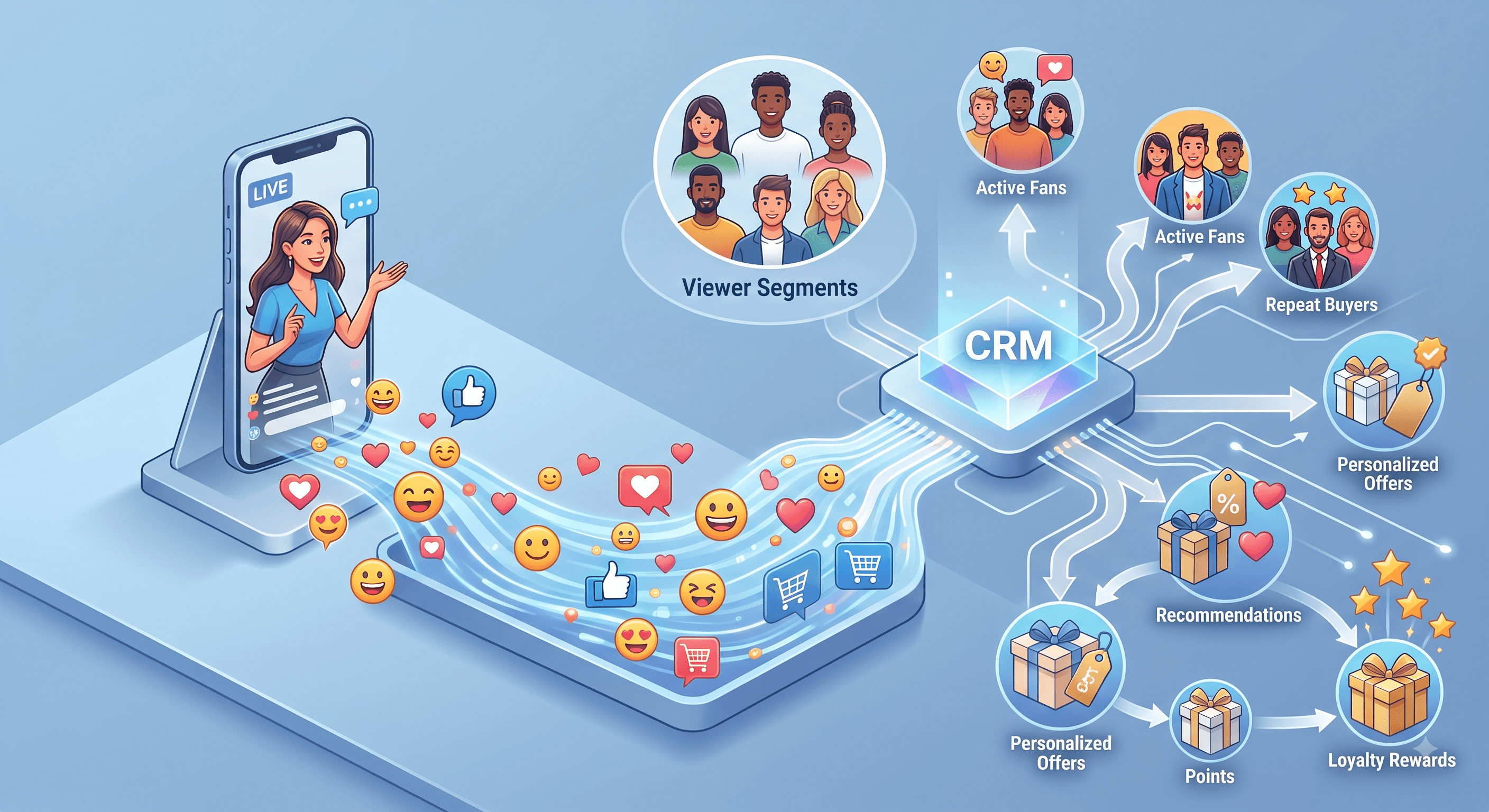
What signals can you only get from live?
Watch time, repeat viewing, coupon claims and redemptions, quiz and poll answers, and which broadcasts a customer turns up for. None of it appears in a standard web or app log.
How long they watched > Watch time is the most direct read on how strong the interest is. There's no reason to treat a 5-minute viewer and a 10-second one the same way.
How often they come back > A one-time visitor and someone who turns up broadcast after broadcast are not the same customer. Repeat viewing points to sustained interest and a real chance of a return visit in a way a single session never does.
Whether they claimed a coupon > Claiming a live coupon means the viewer reacted to a specific offer during the show. And the ones who claimed a coupon but never used it deserve a segment of their own: the intent is there, the decision isn't.
What they answered > A live quiz or a poll collects interests directly. Guessing at taste from product views is one thing. Working from an answer the customer picked themselves is another.
Which broadcasts they keep returning to > You can separate the customer who keeps showing up for fashion shows from the one who shows up for beauty, or for one particular brand. Stack that up over time and you add content-level interest to a profile that purchase history alone can't give you.
Signal | Existing CRM data | Live behavioral data |
|---|---|---|
Interest | Product views, cart adds | Watch time, repeat viewing |
Taste | Inferred from past orders | Quiz and poll answers |
Purchase intent | Cart adds | Coupon claims, verified purchases |
Engagement | App visit count | Broadcast participation, repeat viewing |
Drop-off | Hard to pin down | The exact minute they left |
Content interest | Purchase categories | Broadcasts and content watched |
None of this appears on its own. You have to give viewers something to act on during the broadcast, then record that action against a customer. Announcements, coupons, quizzes and polls are the instruments that create the data, and Shoplive runs all four as in-stream pop-ups. There's more on designing them in Live Commerce Pop-Ups: Tips to Boost Conversions.
What's the biggest difference between ecommerce CRM and live CRM?
It comes down to time. In ecommerce every customer moves on their own clock: one added to cart yesterday, one browsed this morning, one bought 90 days ago. So the CRM fires against each person's individual timeline.
Cart add → reminder 3 hours later
Purchase → repeat-purchase message after 30 days
Last order → dormant after 90 days
Live doesn't work that way. Thousands of customers enter the same broadcast at the same moment and see the same thing. On top of each person's own timeline you now have one clock everybody shares: the broadcast.
Basis | Ecommerce CRM | Live commerce CRM |
|---|---|---|
Timeline | Each customer's own actions | Broadcast time |
Core unit | Customer lifecycle | Broadcast episode |
Segments | New, active, dormant, VIP | First-time, repeat, consecutive attendance |
Message timing | Triggered by individual behavior | Before, during, right after the show |
Key actions | Views, cart adds, purchases | Watching, participating, coupons, returning |
Headline metrics | Conversion, repeat purchase | Return viewing, attendance, participation, conversion |
Data shelf life | Fairly long | Sharpest right after the broadcast |
Take "no purchase in 30 days." In a normal CRM that's a meaningful dormancy signal. For a brand that goes live once a month, it says almost nothing about whether that customer will show up. Flip it around: "attended the last three broadcasts" is a powerful signal in live, and it doesn't exist as a segment in standard ecommerce CRM at all.
Which is why live CRM is better understood not as a separate tool but as one more behavioral axis on the CRM you already run: the broadcast.
Why events aren't enough without segments
Loading live data into a CRM gets you nowhere on its own. It has to land in a segment and a campaign. Two examples of how that chain runs:
Example 1. Watched 5 minutes, didn't buy
Event ·
LIVE_VIEW, 5 minutes watchedSegment · watched 5 minutes or more of a broadcast in the last 7 days, no purchase
Trigger · within 1 hour of the broadcast ending
Message · replay link plus the offer from the show
Example 2. Claimed a coupon, never used it
Event ·
COUPON_RECEIVED, unredeemedSegment · claimed a broadcast coupon, hasn't redeemed it
Trigger · 24 hours before the coupon expires
Message · expiry reminder
That's the chain that turns live data into a CRM asset. The point of live CRM isn't a new messaging channel. It's a new customer signal your existing CRM can act on.
Why watch attendance at the next broadcast?
Because in live, the next meeting is already on the calendar. In ordinary ecommerce nobody knows when a customer will come back, so the CRM's job is to keep nudging until they do.
Live is different. The date and time of the next show are already set. The goal narrows from "get them back eventually" to "get them back for the next show." Which is why conversion rate shouldn't be the only number you watch:
Return-viewing rate: share of viewers who come back for the next broadcast
Consecutive attendance: share attending several episodes in a row
Pre-show turnout: share already in the room when the broadcast starts
Participation rate: share claiming coupons or answering quizzes and polls
Repeat purchase rate: share of viewers and participants who buy again later
The logic is simple. More people coming back means more chances for a purchase to happen. These don't replace conversion rate. They sit upstream of it.
Why pay to reacquire the same viewers every time?
Because you don't know who responded last time. You run ads to promote a broadcast. People come, watch, leave. The next broadcast comes around and you run ads again. The customer who watched 5 minutes last month gets treated like a total stranger.
Connect live data to your CRM and that changes. You can carve out a group like this:
Example segment. Watched 5 minutes or more of the last broadcast · didn't buy · no return visit in 30 days
A win-back message will usually serve that group better than a prospecting ad. At the other end of the range:
Example segment. Attended the last 3 broadcasts · used a coupon · has purchased
That group isn't a promo target. It's your live VIP list. The real value of live data lies there: less in trimming ad spend, more in owning the first-party data that lets you find the customers who already raised their hand. Especially if long-term customer value (LTV) is what you're after.
What changes once you have this record?
Split live viewers by what they did and how many episodes they've attended, and the right message changes with them.
Live behavior | CRM segment | Suggested action |
|---|---|---|
Watched 5 min or more, no purchase | Interested | Replay link and offer recap right after the show |
Claimed a coupon, didn't use it | Still deciding | Reminder before it expires |
Attended 3 or more recent broadcasts | Live regular | Early notice and first look at the next show |
Attended last time, not yet this time | At risk of dropping off | Live alert while the broadcast is running |
Answered a quiz or poll | Stated interest | Recommendations based on what they picked |
Verified a purchase | Live buyer | Review request and repeat-purchase campaign |
Seen this way, live data isn't a broadcast report. It's CRM data you can re-segment on and design the next action around.
Live commerce: what's left when the hour is over?
Live is the longest, closest stretch of attention a brand gets from a customer. And for most brands the result of it still comes down to three numbers: viewers, sales, conversion rate. The questions that matter come after that. Who stayed. Who came back. Who responded to which offer. Who showed interest in what. And what you send them next.
Treat live as a sales channel and the customer data expires the moment the stream ends. Treat it as a CRM touchpoint where behavior happens, and that hour becomes an hour of building customer data.
Of everyone who showed up to your last broadcast, how many could you call by name today?
If you want to start with the signals you can create during a broadcast, Master Shoplive Pop-Up Features for Live Commerce is a good place to begin. For the basics of live commerce itself, try The Complete Guide to Live Commerce.
Frequently asked questions
Q. How is live commerce CRM different from ecommerce CRM?
The biggest difference is the timeline. Ecommerce CRM runs on each customer's own actions, while live CRM also runs on a clock everyone shares: the broadcast. That lets you segment on episode, watch time, participation and return attendance, not just lifecycle stage.
Q. We already use a CRM tool. Do we need a new one?
In most cases the tool isn't the issue. What matters is connecting live behavioral data into it so your existing segments and campaigns can use it.
Q. What data can you actually get from live?
Watch time, repeat viewing, participation, coupon claims and redemptions, quiz and poll answers, verified purchases and other behavior generated during the show. What's available in practice, and how far you can identify individuals, depends on the live solution you use and how it's integrated.
Q. Isn't Kakao Sync or app push enough?
They do different jobs. Kakao Sync brings customers in, and app push and KakaoTalk alerts deliver the message. Live CRM needs the piece in between: the behavioral data that decides who gets what.
Q. What about viewers who aren't logged in?
Viewers who never log in are hard to connect at an individual level over time. So it helps to design moments inside the broadcast, coupons, events, giveaways, that prompt a login or signup and make identifying yourself a natural part of the experience.
Q. Is live worth it as a CRM source if we don't broadcast often?
Density matters more than frequency. A single broadcast can produce watch time, participation, coupon activity, poll answers and purchases. The point is not to let that end as a one-off report but to carry it into the next campaign.


